Week 4: Medicine + Technology + Art

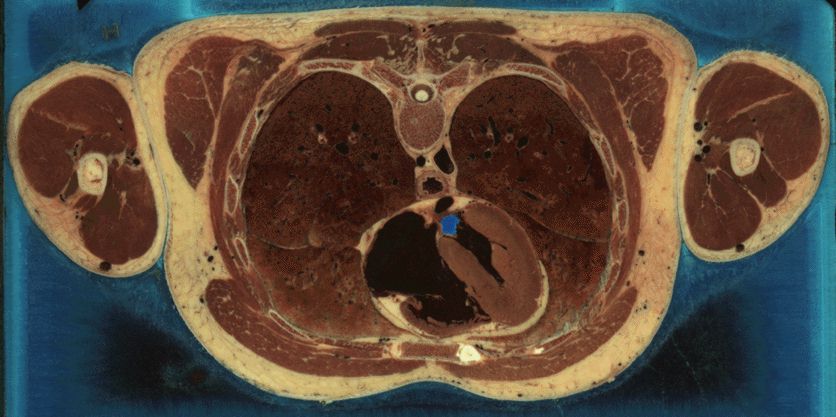
The relationship between medicine, technology, and art was unclear to me before learning about it this past week. However, after watching Professor Vesna’s lecture on medicine and the body and learning about the projects that propelled a greater understanding of the human body (including the Visible Human Project and Human Genome Projects), this intersection began to fascinate me (UC Online Director, 2012). Despite the ethical issues that may accompany these projects (as outlined in the Hippocratic Oath), the ever-changing technology leads me to understand that some dated policies regarding medicine and the human body are built on the foundation of religious or cultural values (Tyson, "The Hippocratic Oath Today"). Thus, art expression through medical technologies became more accepted and experimented within the past century.
 As described in Casini’s essay on the relationship between MRIs and artistic expression, this process of being in the MRI scanner is an artistic expression and a self-portrait in itself (Casini, “Magnetic Resonance Imaging (MRI) as Mirror and Portrait: MRI Configurations between Science and the Arts.”). Similar to a mirror, the MRI is able to scan beyond the exterior skin in order to uncover hidden tumors or health problems. Casini links the scan to personal identity – that perceiving your own body in an MRI scan feels so unnatural that you form projections of your image outside of the scanner.
Sources:
Casini, Silvia. “Magnetic
Resonance Imaging (MRI) as Mirror and Portrait: MRI Configurations between
Science and the Arts.” Configurations, vol. 19, no. 1, 2011, pp. 73–99.,
doi:10.1353/con.2011.0008.
“Magnetic Resonance Imaging (MRI) - Body
Scan.” DoveMed, 25 Apr. 2018, www.dovemed.com/common-procedures/radiology-procedures/magnetic-resonance-imaging-mri-body-scan/.
Online, UC, director. Medicine
pt1. YouTube, YouTube, 21 Apr. 2012,
www.youtube.com/watch?v=Ep0M2bOM9Tk.
Talks, TEDx, director. TEDxAmericanRiviera
- Diane Gromala - Curative Powers of Wet, Raw Beauty. TEDxAmericanRiviera
- Diane Gromala - Curative Powers of Wet, Raw Beauty, YouTube, 7 Dec. 2011,
www.youtube.com/watch?v=cRdarMz--Pw.
“Thorax.” The Visible
Human Project, 2015, www.nlm.nih.gov/research/visible/image/thorax.jpg.
Tyson, Peter. “The Hippocratic Oath Today.” PBS, Public Broadcasting
Service, 26 Mar. 2001, www.pbs.org/wgbh/nova/article/hippocratic-oath-today/.
“VR for Mental Health &
Addiction Recovery.” The Pain Studies Lab at SFU,
painstudieslab.com/portfolio/vr-for-mental-health/.


Hey! I was the same way before watching this weeks lecture about how I was unclear how medicine, technology and art were related. I think it is very brave how Diane Gromala used medical technology as an outlet for her pain.
ReplyDelete